Create your CubeMars account

With the rapid development of humanoid robots, quadruped robots, and the intelligent automation industry, robot joint technology is becoming a major focus of the industry. In robotic systems, joint drive performance often determines the robot’s motion capability, stability, and control precision.
Although traditional servo motors are widely used, the continuously increasing demands for lightweight structures, compact size, and high dynamic performance in robotics have made conventional solutions increasingly insufficient for high-end robotic applications.
Against this background, the “Frameless Torque Motor” has begun attracting increasing attention from robot manufacturers and R&D teams.
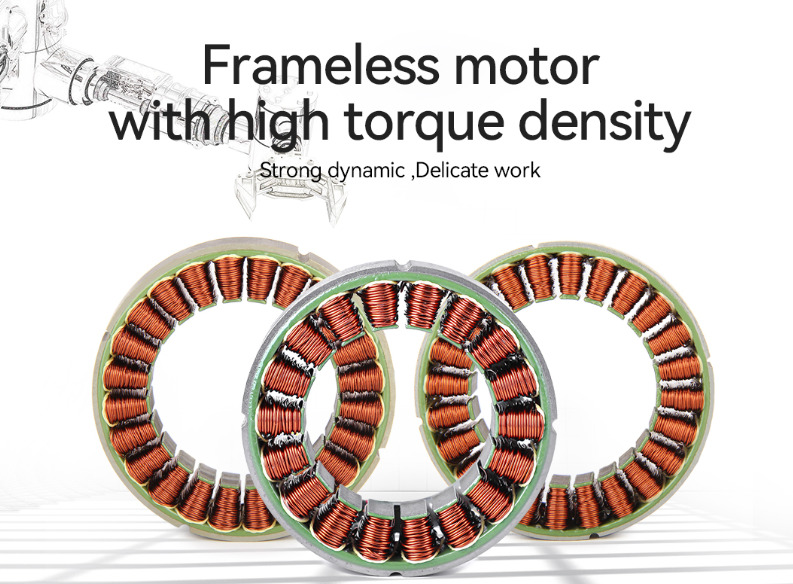
A Frameless Torque Motor is a type of motor specifically designed for high-performance robots and automation equipment. Unlike traditional servo motors, it removes structures such as the housing, bearings, and standard output shaft, typically retaining only the two most essential components:
Stator
Rotor
Therefore, it is called a “frameless” motor.
This design allows the motor to be directly embedded inside the robot joint, enabling developers to freely design the mechanical structure, reduction system, and overall joint module according to actual application requirements.
Simply put, a frameless torque motor is more like the “core power unit” of a robot joint rather than a complete motor in the traditional sense.
Compared with traditional servo motors, frameless torque motors are becoming the core power solution for an increasing number of robotic projects due to their high integration, high torque density, and flexible structural design.
Comparison Between Frameless Torque Motors and Traditional Servo Motors
| Comparison Item | Frameless Torque Motor | Traditional Servo Motor |
| Structure | Highly Integrated | Independently Packaged |
| Size | Smaller | Larger |
| Weight | Lighter | Heavier |
| Torque Density | Higher | Average |
| Customization | More Flexible | Lower |
| Robot Compatibility | Very High | Standard |
With the rapid development of humanoid robots, quadruped robots, and intelligent robotic arms, the robotics industry is placing increasingly higher demands on joint drive systems.
Modern robots not only need to “move,” but also require:
More natural motion
Faster response
More lightweight structures
More precise control
More stable operation
However, due to their larger size and fixed structure, traditional servo motors have gradually revealed limitations in high-performance robotics applications.
Against the backdrop of rapid advancements in robotics and intelligent automation, drive systems are transitioning from traditional motor solutions toward highly integrated and high-performance architectures. Among them, the Frameless Torque Motor, as a highly customizable electromagnetic drive solution, is being adopted by an increasing number of high-end robotic systems.
Unlike traditional motors, frameless torque motors are typically integrated directly into robot joints and combined with reducers, encoders, and control systems to form an integrated structure. This design allows robot joints to become more compact while improving overall motion efficiency and control performance.
Lightweight Joint Design
Frameless torque motors remove the housing, bearings, and output shaft structures found in traditional motors, retaining only the core electromagnetic drive components. This enables direct integration into robot joints and achieves true structural integration.
Application Value: Makes robot joints lighter and more flexible, improving motion response speed while reducing overall energy consumption. This is especially suitable for humanoid robots and quadruped robot systems with high dynamic performance requirements.
High Torque Density Output Capability
By optimizing electromagnetic design and magnetic circuit structures, frameless torque motors can achieve higher torque output within limited space, thereby improving power performance without increasing overall size.
Application Value: Widely suitable for high-dynamic robotic systems, such as quadruped robot jumping and running, humanoid robot walking control, high-load robotic arm operations, and exoskeleton assist systems.
High-Precision Motion Control Capability
Due to low rotational inertia and excellent dynamic response characteristics, frameless torque motors can achieve smoother and more continuous torque output, enabling control systems to deliver higher precision and stability.
Application Value: Helps achieve stable dynamic balance control, compliant interaction control, high-precision trajectory control, and natural gait generation, making overall robot motion smoother and closer to biological movement patterns.
Suitable for Integrated and Modular System Design
Frameless torque motors are typically combined modularly with harmonic reducers, encoders, brakes, and drivers to form highly integrated joint actuator units.
Application Value: Reduces structural complexity and wiring difficulty, improves system integration, and significantly accelerates robot development and iteration speed, making it ideal for rapid prototyping by research institutions and robotics companies.
In the robotics industry, frameless torque motors have already been applied in high-performance robotic projects.
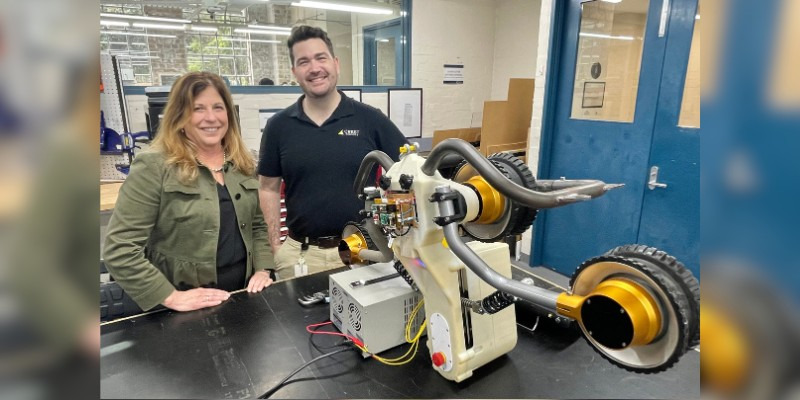
Taking the CubeMars Gorilla Mk1 case as an example, this robot designed for high-voltage transmission line maintenance uses the CubeMars RI80 V2.0 Frameless Torque Motor as its core drive unit.
Gorilla Mk1 is mainly used in complex task scenarios such as overhead transmission line inspection, high-voltage line maintenance, hazardous environment operations, and high-altitude rescue assistance. In these applications, the robot must operate for extended periods in unstructured, high-risk environments while handling dynamic load changes and complex contact conditions.
Therefore, the system design must simultaneously satisfy the following key requirements:
High dynamic stability to handle suspended and inclined operating conditions
Continuous high traction capability to complete line contact and mobility tasks
Precise torque control capability to reduce mechanical impact on transmission lines
Lightweight structural design to improve operational safety and energy efficiency at high altitudes
Under such system constraints, the frameless torque motor is not used as an independent performance unit, but rather as the core power source of the joint drive system. It is embedded into the wheel-drive module and, together with the reducer, control system, and structural components, forms a complete actuator joint.
Its role is therefore no longer limited to single torque output, but instead works collaboratively with the entire drive chain to jointly determine the robot’s motion performance and task execution capability in complex environments.
Specific System Performance Is as Follows:
| Capability Dimension | Practical Performance | System Value |
| High Torque Density | Achieves 280 kg traction capability with an overall machine weight of approximately 20 kg | Ensures sufficient power reserve for inspection tasks under steep slopes and high-load conditions |
| Lightweight Structure | The motor is directly embedded into the drive system without additional housing burden | Reduces overall weight and improves operational stability at high altitudes |
| Highly Integrated Design | RI80 V2.0 is deeply integrated into the wheel-drive structure | Enables a more compact mechanical layout suitable for complex transmission line environments |
| Precise Force Control Capability | Real-time adjustment of contact force and driving force applied to cables | Reduces line wear and improves operational safety |
| Low-Vibration Operation | Maintains continuous and stable movement on overhead transmission lines | Improves inspection reliability and structural durability |
From the Gorilla Mk1 case, it can be seen that frameless torque motors play an important role in the joint systems of overhead inspection robots.
In complex environments such as overhead transmission line operations, robots are required to complete tasks under constraints including unstructured contact conditions, highly dynamic load changes, and long-duration continuous operation. Therefore, the design focus of the joint drive system is not on a single motor parameter, but rather on the coordinated matching of the entire drive chain (motor, reducer, control system, and structural components).
Within this system architecture, frameless torque motors provide greater structural freedom and control precision through embedded integration methods. However, their performance still heavily depends on mechanical design, thermal management conditions, and control strategies.
Therefore, their value in high-end robotic joint systems can be more accurately understood as:
Providing the “electromagnetic drive foundation” with high torque density
Supporting compact joint structure design
Adapting to high-dynamic control system architectures
Meeting the requirements for continuous operation and force-control tasks
Improving system-level integration flexibility
The selection of a frameless torque motor needs to be based on robot joint size, load capacity, and dynamic performance requirements. Different application scenarios correspond to different specification solutions.
In practical projects, selecting a frameless torque motor usually requires focusing on the following key considerations:
Torque requirements
Joint size
Reduction ratio
Thermal dissipation capability
Dynamic response speed
Voltage platform
Different robotic systems have significantly different motor performance requirements, so matching should be performed according to the specific application scenario.
Common Application Scenarios
| Application Type | Joint Characteristics | Selection Focus |
| Dexterous Hand / Small Joint | Small space, low load, high precision | Low inertia + fast response |
| Quadruped Robot | High dynamic impact, frequent start-stop motion | Torque density + impact resistance |
| Humanoid Robot | Multi-degree-of-freedom coordinated control | Force-control precision + integration level |
| Exoskeleton | Long-duration continuous output | Thermal stability + efficiency |
| Industrial Robotic Arm | Stable repetitive operation | Lifespan + precision |
Specific Frameless Torque Motor Model Recommendations
| Application Scenario | Recommended Models | Core Features | Typical Applications |
| Dexterous Hand / Small Robotic Arm | Low inertia, compact size, fast response, suitable for precision control | Robotic finger joints, lightweight robotic arms, educational robots | |
| Quadruped Robot / Collaborative Robotic Arm | High torque density, strong dynamic performance, stable operation | Leg joints, mobile robots, exoskeleton joints | |
| Core Humanoid Robot Joints | High load capacity, strong structural rigidity, stable continuous output | Hip joints, knee joints, industrial-grade robotic arms | |
| High-Dynamic Heavy-Load Systems | High stability, strong impact resistance, suitable for complex working conditions | Inspection robots, heavy-load mechanical systems |
Frameless torque motors are becoming the core power solution in next-generation robot joint design.
By removing the housing and fixed structures found in traditional motors, frameless torque motors can be embedded into joints with greater structural freedom and integrated with reducers, encoders, and control systems to form highly integrated drive units. This structure provides robots with stronger design flexibility while laying the foundation for lightweight structures, high dynamic performance, and high-precision control.
In practical applications, frameless torque motors have already been widely adopted in inspection robots, exoskeleton devices, collaborative robotic arms, and industrial automation equipment. Through deep integration with reducers, encoders, and control systems, they can build more compact and efficient robot joint systems, thereby further improving overall development efficiency and system reliability.
Overall, frameless torque motors are not only an evolution in motor form, but also represent an important trend in robot joint design shifting from “component thinking” toward “system thinking.” As robots continue evolving toward higher degrees of freedom, higher dynamic performance, and more natural human-robot collaboration, the importance of this technological approach will continue to increase.
In the future, with the continued growth of the humanoid robot and AI robotics industries, the application of frameless torque motors in joint drive systems is expected to further expand. In this process, high-performance frameless torque motor solutions represented by CubeMars are also continuously driving robot joint design toward lighter weight, higher dynamic performance, and greater integration levels.